When revenue plateaus, the default instinct is to spend more on ads. More traffic means more sales, right? Sometimes. But often it just means more spend against the same broken conversion system — and your cost per acquisition climbs while your margin shrinks.
There is a more profitable path. And it starts with the assets you already have: the traffic hitting your store, the customers who have already bought from you, and the email list sitting in your Klaviyo account.
The Problem With “Just Spend More”
Paid traffic is a volume lever, not a profitability lever. If your store converts at 1.5% and you double your ad budget, you get double the traffic but the same 98.5% of visitors leaving without buying. Your revenue goes up, but so does your CPA. Your profit margin often stays flat or gets worse.
The stores that scale profitably fix their conversion system first. Then they scale traffic into a store that converts well. In that order — not the other way around.
Layer 1: Convert the Traffic You Already Have (CRO)
Your first revenue lever costs you nothing in extra spend. If your store gets 20,000 visitors per month at a 1.5% conversion rate and an average order value of $80, you are generating $24,000 in revenue. Improve your conversion rate to 2.5% — same traffic, same ad spend — and that becomes $40,000. A $16,000 revenue increase with zero increase in cost.
The areas that move conversion rate fastest:
- Product pages — clearer benefits, stronger social proof, faster load speed, better mobile UX
- Checkout — reducing steps, adding trust signals, offering multiple payment options
- Homepage and landing pages — stronger message match, clearer value proposition above the fold
- Site speed — every second of load time costs you conversions, particularly on mobile
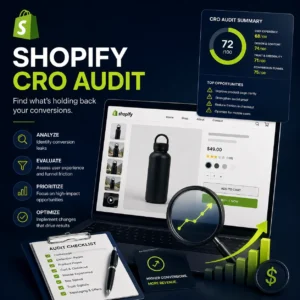
You do not need to rebuild your store. You need to identify the highest-friction points and fix them systematically. That is what a CRO audit does — it shows you exactly where visitors are dropping off and what to fix first by ROI.
Layer 2: Monetise Your Existing Customers (Email)
Your customer list is the most underused revenue asset in most Shopify stores. You already paid to acquire those customers. Every repeat purchase they make costs you close to zero in acquisition.
The key metrics to focus on:
- Repeat purchase rate — what percentage of first-time buyers make a second purchase? Industry average is around 27%. Stores with strong email programs push this to 40–50%.
- Time between purchases — if your product is replenishable, email should be driving reorder timing. Are you reminding customers when they are likely to run out?
- Average order value from existing customers — post-purchase email sequences introducing complementary products consistently increase AOV without additional ad spend.
The three flows that generate the most repeat revenue: post-purchase cross-sell sequences, winback campaigns for lapsed customers, and VIP programs for your top 20% of buyers. Build these before you consider increasing ad spend.
Layer 3: Increase What Each Customer Spends (AOV and LTV)
You have two ways to grow revenue from existing customers: get them to buy more often, or get them to spend more each time. Both are achievable without new traffic.
To increase AOV:
- Bundle products at a slight discount — increases cart size, reduces per-unit shipping cost
- Add a free shipping threshold slightly above your current average order value
- Offer post-purchase upsells on the thank-you page
- Use volume discounts for products customers naturally buy in multiples
To increase purchase frequency:
- Launch a subscription option for consumable products
- Create a loyalty programme that rewards repeat buying
- Use post-purchase email sequences timed to product lifecycle
Layer 4: Reduce Churn and Extend Retention
Every customer you retain is a customer you do not need to reacquire. Reducing churn has a compounding effect on revenue that most store owners underestimate.
Retention comes down to three things: product satisfaction (CRO and fulfilment quality), ongoing relationship (email and communication), and perceived value (loyalty, exclusivity, community). If customers feel like a transaction rather than a relationship, they will not come back.
Look at your cohort data in Shopify Analytics. What percentage of customers from three months ago have bought again? Six months ago? If those numbers are declining, your retention system needs attention before you scale acquisition.
The Compounding Math
Here is what happens when you work all four layers together:
- CRO improves conversion rate from 1.5% to 2.2% — revenue up 47% on the same traffic
- Post-purchase email increases repeat purchase rate from 25% to 38% — another 20% from existing customers
- Bundling and upsells increase AOV from $80 to $97 — another 21% on top
None of those improvements required spending an extra dollar on ads. Combined, they can more than double your revenue from the same acquisition budget.
That is the profit-first approach to Shopify growth. Fix the system. Then scale it. Ad spend is the accelerant — but only after the engine is built.
Want to know exactly where your store is losing revenue right now? Get a free Shopify CRO audit and see the specific fixes that will move your numbers — before you spend another dollar on ads.