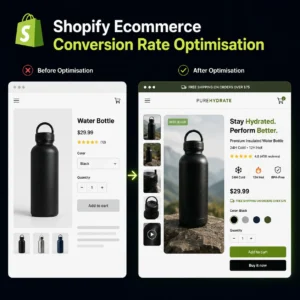
A high-converting landing page used to take a week to produce properly — brief, copywriting, design, development, QA, launch. For brands running multiple campaigns across different audiences and channels, that timeline meant they were always behind. AI is compressing that timeline without compromising quality — when used correctly.
Here is how Shopify stores are using AI to build and optimise landing pages faster, and where human judgement still has to stay in the loop.
AI for Landing Page Copywriting
Copy is where AI delivers the most immediate value in the landing page workflow. Given a clear brief — the offer, the audience, the key objection to address, the desired action — AI can produce a complete landing page copy draft in minutes: headline options, subheadline, benefit bullets, social proof framing, CTA copy, and FAQ content.
What makes a good AI copy brief for landing pages:
- The specific offer — exact discount, bundle, or proposition
- The target audience — who are they, what do they already believe, what are they afraid of?
- The primary objection — what is most likely stopping them from buying?
- The one action — what exactly should they do on this page?
- Your brand voice — examples of copy that sounds like you
With a detailed brief, Claude or ChatGPT will produce a draft that is substantially better than most landing pages in your category. The output still needs editing — for brand accuracy, for factual correctness, and for the emotional nuances that AI consistently misses. But the time to first draft drops from hours to minutes.
AI for Headline Generation and Testing
The headline is the highest-leverage element on any landing page. A 10% improvement in headline conversion rate compounds across every visitor the page ever receives. Testing headlines should be a continuous process — and AI makes generating test candidates fast.
A productive AI headline workflow: give the AI your current headline and ask it to generate 20 alternatives across different angles — outcome-focused, curiosity-driven, social proof-led, problem-agitating, offer-forward. Review the list. Select three to five candidates that feel genuinely different. Run them as A/B tests.
This approach gets you more diverse test candidates faster than brainstorming alone, which means more tests run per quarter, which means faster compounding of conversion improvements. In our CRO work, the stores running the most tests consistently outperform those optimising slowly — AI shortens the creative generation step and lets you run the iteration cycle more often.
AI for Layout and Structure Suggestions
AI design tools (Relume for wireframes, Uizard for mockups) can generate landing page structure suggestions based on your brief and industry. These are not finished designs — they are structural starting points that help you and your designer align on the right information architecture before going into Figma or your Shopify page builder.
For Shopify specifically, page builders like Replo and Shogun are adding AI features that generate section layouts and copy simultaneously. You describe what you need — “a social proof section with three customer reviews and a star rating” — and the AI builds it in the editor. The speed improvement in page construction is significant for teams building pages regularly.
AI for Image and Creative Production
AI image generation (Midjourney, Adobe Firefly, DALL-E 3) can produce lifestyle imagery, background images, and concept visuals for landing pages at a fraction of the cost of photography. For testing creative angles before committing to a full shoot, this is genuinely useful.
Important caveat: AI-generated images for product-forward landing pages rarely outperform real photography of real products in real use. For hero images where the product itself needs to be the centrepiece, invest in real photography. Use AI imagery for supporting visuals, backgrounds, and concept testing.
AI for Post-Launch Optimisation
Once a landing page is live and generating data, AI tools accelerate the optimisation cycle. Microsoft Clarity’s AI surfaces the behavioural patterns that indicate friction — where visitors are rage clicking, where they are dropping off, which sections they are skipping. This data points you toward the highest-priority A/B tests without requiring hours of manual analysis.
Feed that insight back into your AI copy brief for the next test iteration. The cycle looks like: AI-assisted build → launch → AI-assisted analysis → AI-assisted test candidate generation → retest. Each loop gets faster. The compounding effect on conversion rate is real.
The Human Elements That AI Cannot Replace
Two things that require human judgement, regardless of how good AI tools become:
Brand accuracy. AI produces plausible copy, not necessarily accurate copy. Claims about your product, certifications, guarantees, and results need to be verified by a human who knows the product. Publishing AI-generated copy without factual review is a genuine risk.
Audience empathy. The best landing page copy sounds like it was written by someone who has been in your customer’s shoes. AI can approximate this — but the deepest customer empathy still comes from humans who genuinely understand the frustration, aspiration, or problem the product addresses. Use AI for speed. Use human insight for depth.
Fast-built landing pages still need solid CRO fundamentals to convert. Get a free Shopify audit to ensure your pages are built on the right foundation.