Most CRO advice is written for stores that do not have enough traffic to run statistically valid tests. That advice — fix obvious friction points, improve your copy, add trust signals — is useful. But it is a different game once you have the traffic volume to run proper experiments.
Once you are seeing 30,000+ monthly sessions and 500+ monthly conversions, the CRO playbook changes. You stop guessing what might work and start proving what does.
What Changes at Scale
At low traffic volumes, you optimise for confidence. You make changes that are very likely to improve performance based on established principles. You do not test these things because you do not have enough data to detect small differences. You just implement best practices and move on.
At high traffic volumes, you optimise for precision. You can detect a 5% conversion lift with statistical confidence in two weeks. You can test small changes — a headline variant, a different social proof format, a button copy change — and get reliable signal. This is where CRO becomes genuinely compounding, because every validated improvement stacks on top of previous ones.
Building a Testing Programme That Works
Start With a Hypothesis, Not a Hunch
“I think a different button colour might help” is not a hypothesis. This is a hypothesis:
“Our heatmap shows that 40% of mobile users never scroll past the hero section, suggesting they are not seeing the value proposition. Changing the hero to lead with the primary benefit rather than brand imagery should increase scroll depth and conversion.”
The hypothesis format forces you to identify the problem, the proposed solution, and the expected outcome. It also makes post-test analysis more useful — if the test does not produce the expected result, the hypothesis gives you something to interrogate.
Prioritise by Impact and Ease
You will always have more test ideas than testing capacity. The most common framework is PIE: Potential impact, Importance (traffic exposure), and Ease of implementation. Score each idea across these three dimensions and run tests in priority order. High-impact, high-traffic, easy-to-implement tests go first.
Test One Variable at a Time
Multivariate testing sounds appealing — change multiple things at once and find the best combination. In practice, multivariate tests require enormous traffic volumes. Most Shopify stores, even high-traffic ones, are better served by clean A/B tests that isolate one variable and produce unambiguous results.
If you change the headline and the button and the hero image simultaneously, you will not know which change drove the result. If you change only the headline, you will.
Run to Statistical Significance, Not to Calendar
The most common CRO mistake at scale is stopping a test early because one variant looks like it is winning. Let your test run until it reaches 95% statistical significance before declaring a result. Also run tests for at least one full business cycle — if your customers behave differently on weekends versus weekdays, a test that runs Monday to Thursday is not representative.
Where to Test on a High-Traffic Shopify Store
- Product pages: Headline, primary image, reviews placement, ATC button copy, delivery/returns format
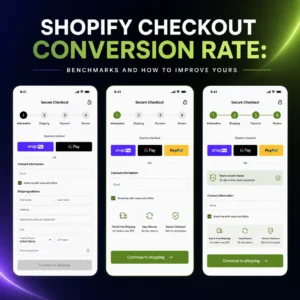
- Checkout: Upsell placements, trust signal placement, payment method presentation, shipping layout
- Landing pages: For stores running significant paid traffic, these are often the highest-ROI testing surfaces because improvements impact paid channel economics directly
The Meta-Skill: Learning Fast
The stores that compound CRO gains fastest are not the ones that win the most tests. They are the ones that run the most tests and learn from both wins and losses. A failed test that teaches you something about your customer’s behaviour is more valuable than a lucky winner you cannot explain.
Build a test log. Document every test: hypothesis, variant, result, and interpretation. Over time, this becomes a body of knowledge about your specific customer that no external consultant can replicate. It is a genuine competitive moat.
Case Study: Seven Data-Backed A/B Tests Generated $1.82M in Additional Revenue for GolfCoursePrint
When GolfCoursePrint came to us, their previous CRO agency was running one to two tests per month, focused on low-impact changes, and failing to implement winning variants consistently. We rebuilt the entire testing programme around behavioural data: Google Analytics, heatmaps, session recordings, and on-site polls.
Running at least five data-backed A/B tests per month, with immediate implementation of winners, the results across seven winning tests were:
- 63% overall increase in conversion rate
- Total revenue growth from $2.1M to $5.2M annually
- $1.82M in revenue directly attributed to CRO
- All achieved in under 120 days
The seven winning tests:
- Adding Instagram UGC to the homepage: +28.80% CR
- Removing cart drawer upsells: +11.95% CR
- Repositioning high-engagement homepage sections: +11.40% CR
- Replacing hero video with static image: +4.97% CR
- Hiding irrelevant product variants: +4.19% CR
- Surfacing USPs above the fold: +2.17% CR
- Adding a shipping transparency widget: +1.22% CR
Every test was grounded in behavioural data. None were guesses about what “might look better.” The programme ran on a structured cadence: analyse, hypothesise, test, implement, repeat.
Running high-traffic volume but not sure where to focus your CRO effort? Get a free Shopify audit and we will identify the highest-leverage testing opportunities in your specific funnel.