Getting a Shopify store to $100K is a milestone many reach. Getting to $1M is where most plateau. The distance between those two numbers is not just about doing more of what got you to $100K. The growth levers that work at $100K are different from the ones that work at $500K, which are different again from what gets you to $1M.
Here is the growth map that matters at each stage.
The $100K Stage: You Have Product-Market Fit, Now Make the Store Work
If you are at $100K annual revenue, you have validated demand. Customers are buying. The product works. The problem is rarely the product — it is the store around the product.
Typical constraints at this stage: conversion rate below 1.5% because the store was built fast, not optimised; no email programme beyond a basic abandoned cart sequence; all revenue from paid traffic with no organic foundation; no repeat purchase strategy — every sale is a first sale.
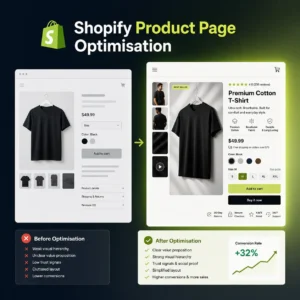
Priority actions: lift conversion rate to 2%+ through product page and checkout improvements. Build core email flows (welcome series, abandoned cart, post-purchase). Start tracking repeat purchase rate and understand your customer lifetime value. These three things alone have more growth leverage than any increase in ad spend.
The $200K–$400K Stage: Systematise What Is Working
By the time you have reached $200K–$400K, you know what is working. The challenge is systematising it so that growth is not dependent on your personal attention to every detail.
Key milestones at this stage: a functioning email programme generating 20–30% of revenue, a conversion rate above 2% blended, and some organic acquisition channel (SEO, social, referral) supplementing paid. Your AOV should be optimised — bundles, upsells, and free shipping thresholds are active.
Priority actions: scale paid acquisition now that your conversion rate and retention economics support it. Build organic content (SEO blog, social presence) that will compound over the next 12–24 months. Start A/B testing systematically to compound CRO gains.
The $500K–$700K Stage: Hitting the Ceiling
This is where many stores plateau. The tactics that got you here — scaling paid ads, adding new ad creative, iterating on email — are producing diminishing returns. The ceiling is usually caused by one of:
- Audience exhaustion in paid channels — you have shown your ads to most of the addressable audience
- Operational constraints — fulfilment, team, supplier capacity — that limit scaling
- Unit economics that do not support higher ad spend — CAC rising, margin compressing
- Product range limitations — too dependent on one or two SKUs
Priority actions: address the specific constraint. If audience exhaustion: diversify acquisition channels (new platform, international markets, influencer, affiliate). If operational constraints: invest in systems and team. If unit economics: improve conversion rate, AOV, or repeat purchase rate before scaling spend further.
The $700K–$1M Stage: Professionalise the Business
Reaching $1M requires the business to operate professionally — systems, data, team, and strategy working together rather than being held together by the founder’s effort. At this stage, the growth blockers are typically organisational rather than tactical.
What needs to be true at $1M: a leadership team (or at least key operational hires) that handles the business without requiring founder involvement in every decision. An analytics stack that surfaces data to decision-makers quickly. A retention programme generating 30%+ of revenue. Multiple acquisition channels that collectively lower blended CAC. International revenue as a meaningful percentage of total.
The Consistent Truth Across Every Stage
The stores that reach $1M and beyond all share one characteristic: they work on their growth system before the need is acute. They invest in CRO before conversion rate is a crisis. They build email before email is their only viable channel. They hire before being overwhelmed.
Growth that compounds requires building the infrastructure for the next stage before you have fully outgrown the current one. The question is never “what is holding us back right now?” It is “what will hold us back in 12 months if we do not address it today?”
Want to understand which stage your store is at, what is limiting your growth, and what the right next lever is? Get a free Shopify audit and we will map your store against this framework with specific, prioritised recommendations.