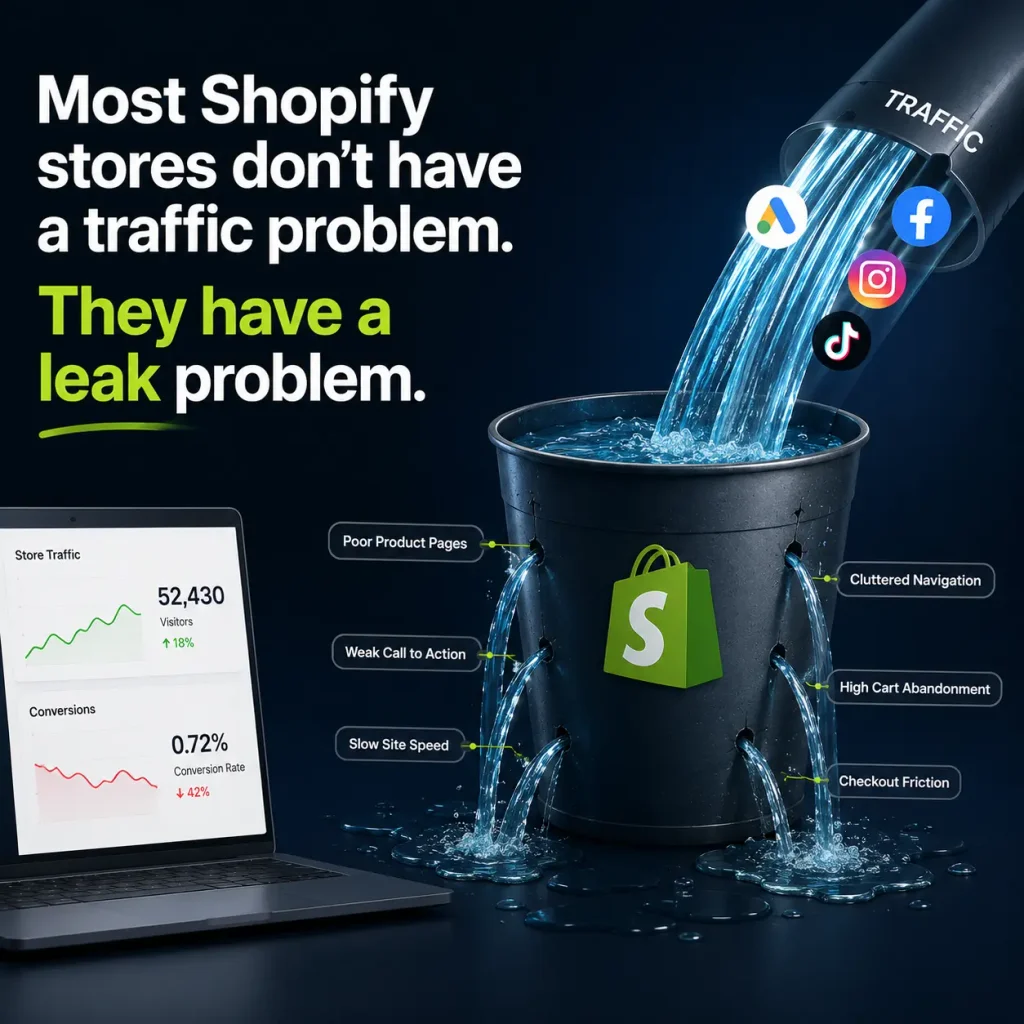
If your ads bring visitors but few orders, the next step is to find where the buying journey breaks down. It could be the offer, the product page, the cart, the checkout, or the match between the ad and the page.
This guide shows how to diagnose those problems, choose what to fix first, and turn the findings into a practical Shopify CRO plan.
What is Shopify CRO?
CRO stands for conversion rate optimization. On Shopify, that usually means helping more of your existing visitors complete a purchase.
The work can include customer research, clearer copy, product-page design, navigation, checkout improvements, and controlled experiments. A better-looking store is useful only when it also helps shoppers understand the offer and move through the buying journey.
Conversion rate is one part of the picture. Track these measures together:
- Purchase conversion rate: the percentage of online-store sessions that result in a purchase.
- Average order value: how much revenue each order brings in, using a consistent sales definition.
- Revenue per session: online-store revenue divided by online-store sessions over the same period.
- Contribution profit: what remains after the relevant product, delivery, payment, discount, and acquisition costs.
Use the same time period and sales channel when comparing them. If you measure revenue per unique visitor instead, label that clearly. Visitors and sessions are different denominators.
A change can raise conversion rate while reducing profit. A large discount might increase orders but leave less money after costs. An upsell might increase order value while putting off enough buyers to reduce revenue per session. Judge the whole outcome.
Why fixing conversion leaks can help before increasing ad spend
More traffic sends more people through your existing experience. It does not remove an unclear offer, a difficult size selector, or an unexpected shipping charge.
Here is a simple illustration. It assumes one order per purchasing session, a £60 average order value, and the same traffic volume in both cases.
| Measure | Starting point | Illustrative improvement |
|---|---|---|
| Online-store sessions | 10,000 | 10,000 |
| Purchasing sessions and orders | 200 | 230 |
| Purchase conversion rate | 2.0% | 2.3% |
| Revenue | £12,000 | £13,800 |
| Revenue per session | £1.20 | £1.38 |
That is £1,800 more revenue from the same number of sessions. It is an example of the arithmetic, not a promised result. The business still needs to account for the cost of the work and the costs of fulfilling those orders.
The useful question is: what is stopping the traffic we already have from becoming profitable orders?
Start with a Shopify CRO audit
A useful audit combines what your data shows with what customers experience. The numbers help locate a problem. Customer research helps explain it.
1. Check the measurement
Confirm that purchases, cart additions, and checkout activity are being recorded. Before interpreting a rise or fall, check the reporting dates, sales channels, and any tracking changes.
Shopify’s Conversion rate breakdown report distinguishes sessions with cart additions, sessions reaching checkout, and sessions completing checkout. A rate based on all store sessions differs from the percentage progressing from one step to the next.
Also check whether the report uses an open or closed funnel. A closed funnel counts the steps in sequence; an open funnel can include shoppers entering later in the journey. Shopify also notes that more than one order can occur in a session, so orders and purchasing sessions need not match.
2. Compare relevant groups
Separate mobile and desktop, new and returning visitors, and traffic sources where the reporting supports it. Look at the pages people actually land on.
A cold social-ad visitor and a returning customer arriving from an email have different questions. Comparing their blended conversion rate can hide the problem you need to solve.
Compare similar products and offers too. A high-price product that needs research should not be judged by the same buying pattern as an inexpensive repeat purchase.
3. Locate the weak part of the journey
Look at product discovery, cart additions, checkout starts, and completed purchases. A drop-off gives you a place to investigate, not an automatic diagnosis.
For example, repeated visits to size information might mean it is hard to understand. They might also mean shoppers are comparing options carefully. Read the page, watch the full recording, and ask customers before deciding which explanation fits.
4. Investigate the customer’s questions
Use interviews, support tickets, reviews, surveys, and session recordings to understand what buyers need to know. Look for repeated questions about fit, results, delivery, returns, price, or how the product works.
Turn the finding into a specific recommendation. “Improve the product page” is too broad. “Add a size comparison beside the selector because customers repeatedly ask which size fits their use” gives the team something clear to build and evaluate.
5. Choose the work with the strongest case
Prioritize the size of the opportunity, the strength of the evidence, the traffic exposed to it, and the effort required. A broken purchase control deserves a different response from an uncertain headline idea.
For the detailed method, use the Shopify CRO audit framework. The Shopify analytics guide explains the measures behind those decisions.
Improve the full buying journey
A shopper needs to find a suitable product, understand its value, choose the right option, and pay with confidence. The page you improve should match the part of that journey where the evidence points.
Homepage, navigation, collections, and search
The homepage should explain what the brand offers and give different visitors useful routes into the store. A new visitor may need context and proof. A returning customer may want a fast route to a familiar collection.
Collection pages need product information that helps people compare. Check category names, images, prices, filters, and sort options. Search should help people find the items they mean, including when they use a different word from the catalog.
Check whether shoppers reach suitable products and continue toward purchase. A higher click rate to an irrelevant product is not necessarily progress.
Product pages: answer the buying questions
The product page should help a shopper understand what they receive, why it suits them, which option to choose, and what happens after ordering.
Review the image gallery, benefit summary, price, variants, delivery details, returns, and genuine customer proof. The best arrangement depends on the product and the customer’s questions. A useful lifestyle image shows context; a detail image may be needed to explain fit, texture, scale, or a particular feature.
In the Sleepy Doe redesign concept, we bring short product details into the summary and put a size-guide link beside the size choices. The original already has reviews and size buttons; the aim is to make the information easier to use together. This is a proposed design, not a measured conversion win. Product details and imagery need confirmation before launch, followed by checks of size-selection errors and completed purchases. Use the product-page optimization guide to diagnose the content, and the product-page template guide for layout planning. The add-to-cart guide focuses on measuring that stage. Check the definition of the rate before comparing it with another report.
Cart: confirm the order and keep the next step clear
Shoppers should be able to check their items, change a quantity or option, understand costs, and proceed. An upsell should help the current purchase rather than block it.
Judge cart offers with conversion rate, order value, revenue per session, and profit. A higher average order value is not enough if too many shoppers leave. See the Shopify upsell and cross-sell guide for placement ideas to evaluate.
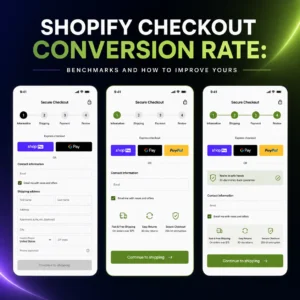
Checkout: make completion easier
Check payment errors, delivery choices, unexpected costs, account requirements, and the experience on a real phone. Some issues can be solved in the product page or cart before shoppers reach checkout.
What you can customize depends on the Shopify plan, checkout surface, and app. Confirm the current Shopify checkout customization options before planning a change.
Read the checkout optimization guide for implementation ideas and the checkout conversion-rate guide for measurement. Recovery emails can help eligible shoppers return, but they do not replace fixing the root problem. The cart-abandonment recovery guide covers that next step.
Mobile experience and performance
Complete the whole buying task on a phone: find the product, read the information, select a variant, add it to the cart, and move through checkout.
Look for hard-to-use controls, overlays that block content, unstable layouts, and missing information. Use performance data to identify the page or script worth investigating. Avoid assuming every mobile problem is caused by a large image.
The mobile conversion guide and Shopify speed guide cover these checks in more detail.
Build a test plan from evidence
A test starts with a reason to expect a change will help a particular audience.
For example: because customers ask about delivery before ordering, we believe showing accurate delivery information beside the purchase controls will help first-time shoppers decide with more confidence.
Define the audience, primary outcome, and guardrails before launching. An add-to-cart improvement should also be checked against completed purchases and revenue. Record what changed, how traffic was assigned, and how the result will be judged.
There is no monthly-session threshold that guarantees a useful test. Your baseline conversion rate, the effect you want to detect, traffic reaching the tested page, and the statistical method all matter.
With limited traffic, start with broken functionality, customer research, and usability work. Before-and-after reporting can help monitor a change, but it cannot isolate its effect from seasonality, campaigns, or other changes.
Use the Shopify A/B testing guide for the method and ecommerce test ideas for hypotheses to investigate. Ideas are starting points, not guaranteed winners.
What changes with Shopify Plus CRO?
The research process stays the same. Start with the buyer, the evidence, and the business outcome.
Plus can introduce additional checkout and operational capabilities, while larger stores may have more complex catalogs, B2B requirements, and international buying journeys. Some features depend on the plan, app, and implementation, so confirm the specific capability before recommending an upgrade.
The question is whether a particular limitation is preventing a valuable improvement, and whether solving it justifies the cost. Upgrading the plan does not fix unclear product messaging or an unhelpful image gallery.
The Shopify Plus CRO guide explores the opportunities to assess alongside Shopify’s current documentation.
The Profit Before Scale Framework™
At Esellence, I organize the work into four stages:
- Diagnose the leaks. Find where the journey loses buyers and gather evidence about why.
- Fix the fundamentals. Improve the offer, messaging, and usability where the evidence is strongest.
- Build and test. Create focused changes and landing pages around a clear customer question or ad angle.
- Scale what works. Apply validated lessons where they fit, while recording losing and inconclusive ideas too.
Each stage should lead to a clear next action. Read how the framework works or review our CRO work and case studies.
When should you use Shopify CRO services?
An independent CRO partner can help when you have traffic and demand but lack the time or skills to turn research into implemented improvements.
Look for a process that connects evidence, recommendations, implementation, and measurement. Ask what the audit produces, who builds the changes, what happens when a test loses, and how the work affects revenue and profit.
I’m Saidal Khan, the Shopify CRO consultant behind Esellence. I work directly on the offer, messaging, and user experience. You can review the current CRO services and packages or apply for a free Shopify CRO audit to start with your store’s priorities.
Shopify CRO questions
What is a good Shopify conversion rate?
There is no single target that fits every store. Compare similar products, traffic sources, devices, and time periods. Use industry research only when its sample and metric definition fit the comparison. Then look at your own trend alongside revenue and profit.
What should I improve first?
Fix broken buying functionality first. After that, investigate the stage with the strongest evidence of a costly problem. It might be product discovery, the offer, product information, the cart, or checkout. The most visible page is not automatically the right priority.
Do I need Shopify Plus to do CRO?
No. Research, clearer product information, navigation, offer testing, and many other improvements are possible without Plus. Check the specific plan and app requirements for the change you want to implement.
How long does Shopify CRO take?
It depends on the work, implementation effort, traffic exposed to a test, and the result you need to detect. Fixing a broken control and evaluating a small conversion change are different tasks. Agree on the deliverables and evaluation method before starting.
Can I improve conversion without A/B testing?
Yes. You can fix defects and use customer research and usability testing to improve the experience. Keep the strength of the conclusion clear: a researched recommendation and a controlled experiment provide different kinds of evidence.
How do I know whether CRO worked?
Check the agreed outcome and guardrails over a suitable period. Use consistent measurement and account for campaigns, offers, seasonality, and other changes. A controlled test can support a stronger causal conclusion than an unsegmented before-and-after comparison.
Choose one useful next step
Start with a clear diagnosis of your own store. Identify the problem, gather evidence, choose the change, and decide how to evaluate it.
If you want help turning that into a focused plan, apply for a free Shopify CRO audit.